
Are Australians liars?
There is a lot to learn from parts of the world with more direct communication.

It’s no secret that Australians tend to “beat around the bush” to save face, but is it actually more harmful than we think? Here’s what Cheek journalist, Bernadette Clarke, has learnt after falling in love with someone from a more direct culture.
At my first European music festival in the Netherlands I was having a yarn with a random Dutch man (as you do). When I mentioned I was from Australia, the guy looked me dead in the eye and yelled “all Australians are liars!”. I thought we were known for our life-threatening animals, not for being distrustful.
I was confronted again at the Dutch restaurant I worked at in Amsterdam when my colleague, Noah, asked me if I preferred to take over downstairs or upstairs. I paused and before I could get any words out he said “oh just tell me the truth!” It was painstakingly obvious I was about to waffle before I got to the point.
Noah told me he doesn’t go to his Aussie friends for advice because they only say what they think he wants to hear. But his Dutch friends? Well, they say it how it is. In the book the Culture Map which decodes cultural differences when it comes to communication styles, an interviewee notes: “In the Netherlands, if you don’t say it straight, we don’t think you are trustworthy.”
Turns out, our lack of directness has given us a reputation for being deceitful.
In my first few months living in Amsterdam I eventually noticed that the Dutch mastered speaking in a straightforward, yet non-confrontational way, while Australians certainly beat around the bush. I’m not sure whether that makes us liars but I am curious, why are we like this? Why are so many of my friends too scared to ask the waiter for sauce? Why do we feel the need to dress up criticism before getting to the point?
Falling in love with a Dutchie meant I had to make sense of the layers of directness and my lack thereof. It was also pretty crucial for me to understand their key communication style so I didn’t cry every time my partner, Mark, opened his mouth.
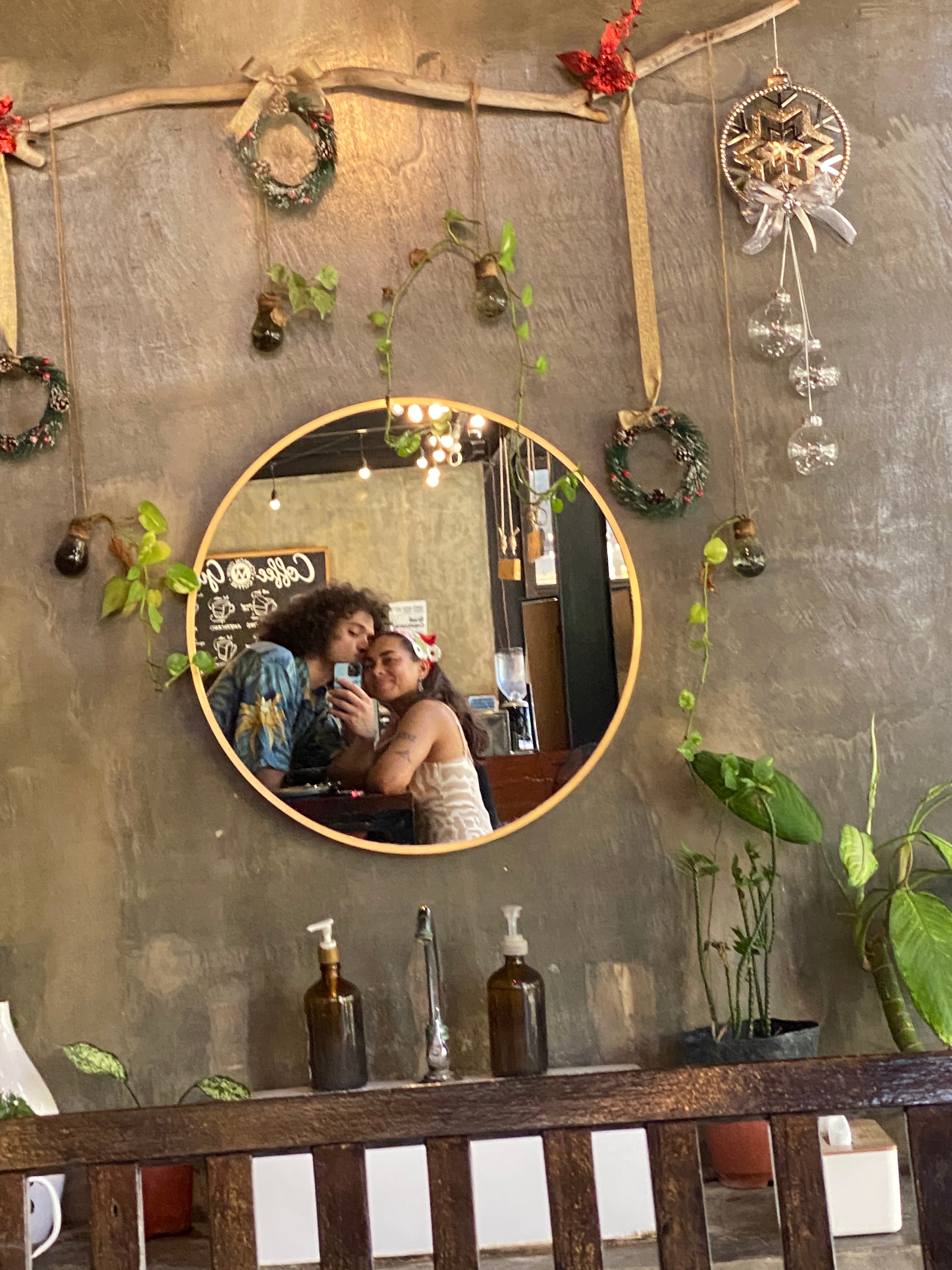
Mark first caught my eye in a little surf town in the Philippines, he was outrageously tall for a Filipino and that’s because he turned out to be Dutch too. We instantly connected one Bingo night over our shared identity crisis that so many mixed heritage kids experience, and after a couple of drinks it was easier to talk about.
When the night was drawing to a close, he offered to put me on his bicycle and ride me home. I was utterly confused by the suggestion, unaware that it’s a Dutch tradition to take cute girls around on their bikes. When he couldn’t unlock his own bike (it was new apparently), I walked myself home. We met for breakfast the next morning and I remember thinking his laugh and hospitality felt very pinoy and familiar to me. But in hindsight, it was the Dutch directness that got us over the line.
After breaky Mark simply said “I like your vibe, can I kiss you?”
(I said “eeep… yes!!!”)
Nothing screams directness more than someone declaring they want to kiss you after eating eggs stone-cold sober. Would an Aussie guy do this? I don’t think so.
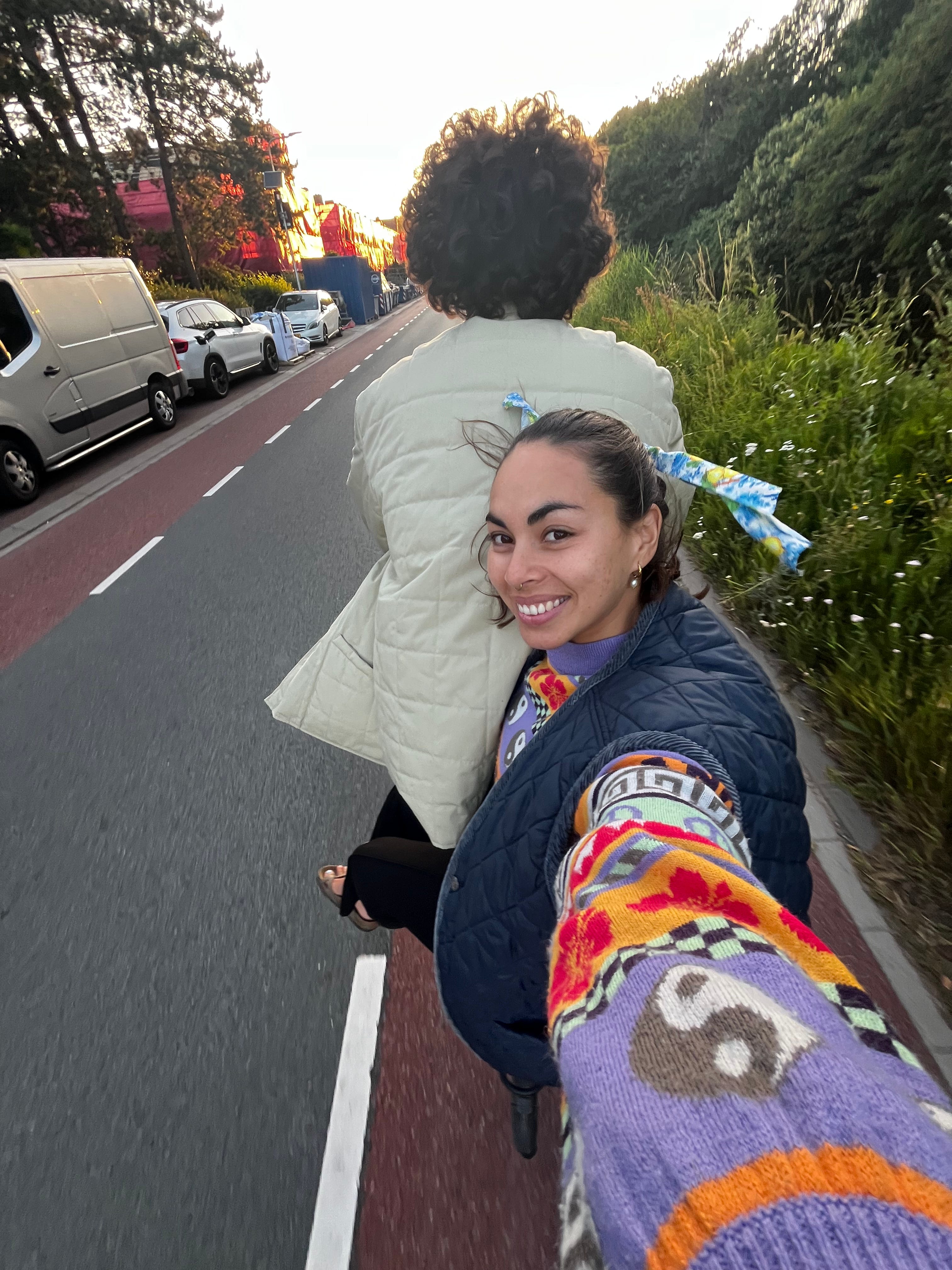
It was that straightforwardness that got the ball rolling. That day I had to leave to catch a plane, so if he never asked me to kiss him then I wouldn’t have known he was interested. The paradox is that when I followed him to Amsterdam months later, it was the directness that I really struggled with. I think a big reason for that is because I just wasn’t used to it back home.
Direct questions like: “Why haven’t you learnt Dutch yet?” or “Why would you want to live here?” threw me off guard, not because they were mean, but because in Australia such interactions would typically be dressed up in politeness.
To the Dutch, such directness is considered polite.
After living in Amsterdam for one year I learnt many things. Number one, don’t refer to the Netherlands as Holland. Number two, don’t mistake a Dutch person for a German. Thirdly, for the love of God, never walk in the bike lane, and well, lastly, Dutchies and Aussies are like chalk and cheese.
The Dutch have engineered their tiny country into existence - reclaiming land from the sea, and thinking intricately about what they’re going to do with every square metre from canals to bike lanes. They’re planners, and they’re efficient.
They have a “doe normaal” mentality which literally translates to “be normal” - I can’t imagine someone saying that in Australia, we are way too rowdy to accept such a request.
It’s no secret that Australia’s environment is vastly different with its rugged coastline, dry deserts and native animals like kangaroos that might jump out at your car if they feel like it. It’s an unpredictable country, but I think it’s fair to say that Aussies are pretty laid back.
I’m sure it’s something about living in a warmer climate that allows us to diddle daddle. But Dutchies don’t have the luxury of time to waffle when temperatures drop to freezing at 0 degrees or lower some winter days. Having to jump on my bike to ride home in the rain or snow only strengthened the case of directness for me, and eventually I started practicing it for myself. Conversations outside were short and to the point. I’d eventually feel more comfortable telling the waitress if they got my order wrong, and I stopped myself from sending a three-page essay to my boss to justify being sick, instead I just got to the jist.
One of the most important things I learnt in the Netherlands is the beauty of directness, and how it sits differently to bluntness and rudeness.
The distinction was explained to me like this: if the speaker is telling you a truth from a place of good intent, then they’re speaking directly. Not to be confused with bluntness which could be a harsh truth, however, told with minimal effort affecting someone. Whereas rudeness? Well, it is the most obvious: when the speaker is being mean.
I’m not saying that there’s no directness back home. I have two close friends - thank you Sage and Maddie - who, without realising, prepared me for the Netherlands with their constant candid truths (sometimes perceived as rude by others). They’d tell me to stop trying to please everyone, while being the type of friends who would never talk shit behind my back because they would’ve already said what they needed to say to my face.
Having straightforward friends was still not enough to prepare me for the culture shock.
The thing is, there’s more layers to Dutch directness. One I wasn’t aware of is that they tend to take everything you say literally. This one time I called my Dutch partner a “dickhead” in casual conversation and he got quite upset. Mark knows swearing can be pretty Aussie as he’s well rehearsed in putting on an accent and saying “ya mad c***” but this moment was different, because it was directed towards him. If you say something in the Netherlands, you mean it. I definitely didn’t really mean he was a dickhead. A Dutchie might perceive me as a liar in that instance, perhaps.
This might sound crazy but there; no means no, yes means yes and maybe means maybe.
In Australia? We have; yeah, nah, yeah nah, nah yeah nah and my personal favourite; yeah nah yeah.
Words have more weight there. If you tell someone you’re going to catch up with them, you mean it. If you ask someone “how are you going?” they will respond truthfully. The more I think about it, the more I find it strange that in Australia our words feel emptier.
There’s a lot to learn from the Dutch. There’s lessons in being completely honest, giving truthful advice and criticism detached from guilt. While the Dutchies could learn a thing or two from us on being more playful or laid-back (though I wouldn’t dare telling anyone that in the middle of European winter!).
If you don’t like something? Say it. Someone has something in their teeth? Let them know. Your friend is annoying you? Tell them. If what you’re saying is coming from a good place, then there doesn’t need to be any fear in telling the truth.
While I can appreciate Australian politeness, I think it’s important to remember that directness, if mastered well, typically comes from a good place; efficiency, honesty and progress.
And I think we can all try our best to practice directness a little more.
About the author:
Bernadette Clarke is a Digital Journalist at Cheek Media. As a third-culture kid, she is passionate about writing from a Filipina-x-Aussie lens. Bernie, as we more affectionately call her, is also an avid ocean-lover who grew up in a small coastal town, so she is committed to reporting on regional affairs and the effects of climate change.

This terrific piece made me think about my own direct communication, which as a late-recognised autistic, I have only just begun to feel more OK about.
I hope (?) that my own directness - along with the additional details I would appreciate if the communication were being directed to me - come from a well-intentioned place such as kindness, helpfulness (sometimes unwelcome), a desire to get to the point faster without wasting both of our time, my need for a shared clarity between us that I believe will benefit us both (often unwelcome).
I think I usually welcome direct communication that leaves me without doubt about what people are saying with little room for doubt? I'm pretty thick-skinned, except when I'm not???
I fume at films and series where too much of the dialogue is left unsaid. For example, where parents fail to tell their children that despite their obvious anger, nothing could stop them from loving their child. Or where people fail to discuss the obvious, one thing that would help to resolve their differences.
My guess is that most of those would have been American film projects?
I'd never thought of a lack of communication directness as being an Aussie trait. It's interesting to see it that way, along with the welcome directness of the Dutch.
Maybe it's more about my journalism training and wanting everyone to give the summary and main point in the the opening sentence.
But mostly I just want to stop myself from biting my tongue while rolling my eyes and wishing for the people I'm speaking with to get to the damn point.
Yes! I've experienced this with a European sister-in-law. My mum and dad have struggled with her 'blunt' delivery whist she has been frustrated with us not meaning what we say (e.g. saying something is 'absolutely fine' when it's really not - an old family favourite). She has taught me quit the mealy-mouthing and just say the thing.