

Australia has a world-leading record of arresting climate protestors, meanwhile multi-billion dollar corporations are perfecting the tactic of “legal bullying” to intimidate their critics, writes Cheek’s Varsha Yajman.
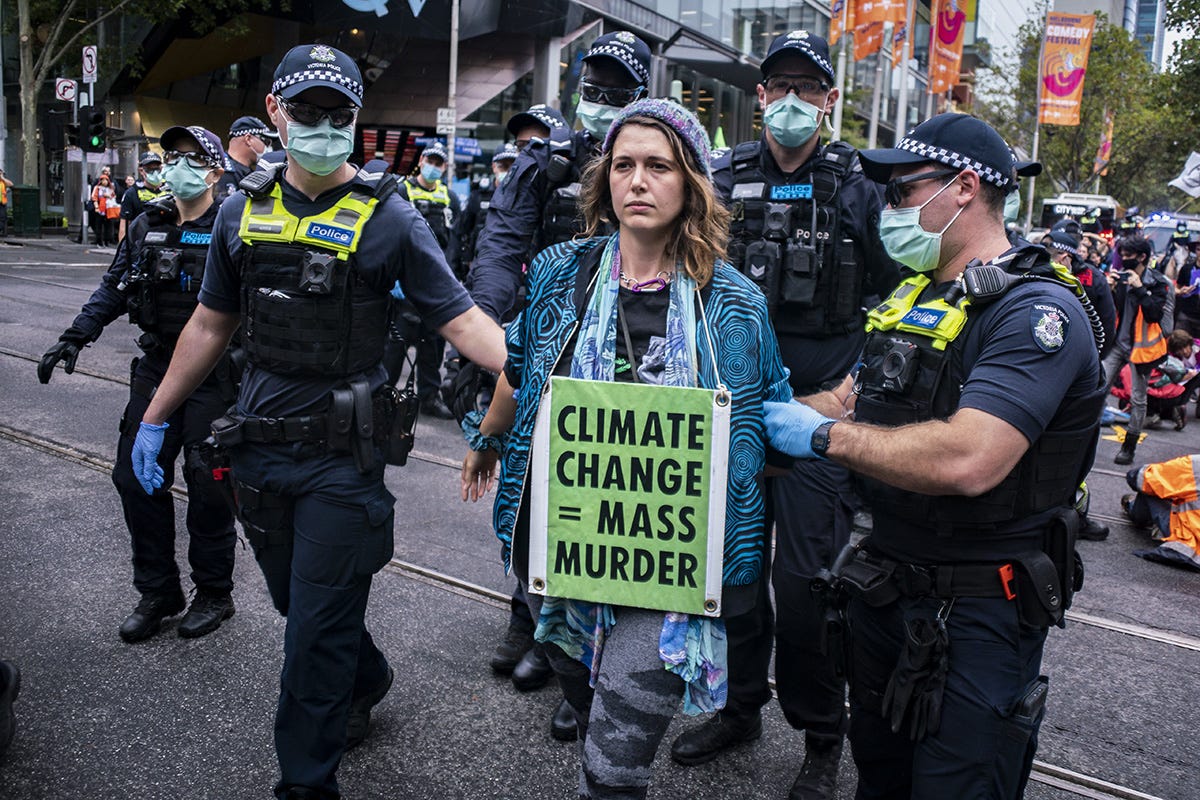
In November 2025, NSW Police arrested 141 people who attempted to block the shipping channel in Newcastle Harbour during Rising Tide protests. It included 18 children - one of them was just 15.
A year earlier, 170 were arrested for doing the same.
This huge number of arrests is what sees Australia leading the world in arresting climate protestors. Over 20 per cent of all climate and environment protests in Australia involve arrests - more than three times the global average.
Australia’s democracy is at risk. Voices are being silenced; dissent is being suppressed. Arresting climate protestors is one way governments can silence public dissent. Another way is the use of SLAPP Suits by multi-billion-dollar corporations.
Both of these methods are slowly eroding our democracy and are a form of legal bullying.
The rise in anti-protest laws
Over the last ten years, Australia has seen at least 49 laws affecting protest introduced in federal, state and territory parliaments. NSW leads the way with the greatest number of anti-protest laws, while the harshest financial penalties are seen in South Australia - fines can go up to $50,000 for common protests.
Co-founder of Climate Defenders Australia (CDA), Julia Grix, tells Cheek there has been an increase in arrests at climate protests since she began working in the field.
CDA is a legal service focused on the needs of defenders who put themselves at risk to call for action on the climate crisis to address the “critical gap in access to justice”. The group represented more than 100 people arrested in November 2025 and saw prosecutors drop all charges against the protesters in August 2026.
“When I first started practising law in this area, only a few years ago, receiving a custodial sentence for participating in a peaceful protest was simply unheard of,” says Grix.
For Grix, it is not just the arrest rate that is concerning, but police conduct, which sees excessive force and methods such as surveillance and pepper spray used against protestors.
This increase in arrests and excessive use of force against climate protestors comes at a time when the urgency to act on climate change is ever increasing. Just last week the UN Environment Program published a report acknowledging that, under current policies and near-term trajectories, warming of more than 1.5C is now “widely assessed as unavoidable”.
Legal director at the Human Rights Law Centre, Sarah Schwartz, has observed the same trend in arrests. She notes that it’s not just climate protests that are under attack, but also Palestine solidarity demonstrations, with governments using the parrot narratives about “public safety, hate crimes, social cohesion and terrorism to justify restricting protest rights”.
These restrictions on protests have significantly affected Australia’s civil rights to freedom of association, peaceful assembly, and expression. CIVICUS Monitor, a group that analyses the extent to which civil society rights are being respected and upheld, rated Australia’s civic space as “narrowed.”
The role of the corporates
As governments use the narrative of public safety to crack down on public dissent, multi-billion-dollar corporations use their wealth and power to suppress protest. The Human Rights Law Centre’s acting associate legal director, Regina Featherstone, said Strategic Lawsuits Against Public Participation (SLAPP suits) are “in essence, weaponised legal proceedings”.
Featherstone said that the voices and work of journalists, activists and those such as victim-survivors of abuse, NGOs and whistleblowers are being repressed and silenced by “tying them up in litigation and draining their resources”.
In these cases, the merits of the person fighting the case, such as an activist or journalist, do not matter, as the drain of resources usually makes it difficult to fight off a SLAPP suit, Featherstone added.
“Our democracy is built on fundamental rights and freedoms like the right to public participation, freedom of expression and freedom of assembly. If we cannot speak out and hold powerful people, companies and governments accountable, then we have lost a fundamental pillar of democracy”.
The Woodside stink-bomb
In July this year, Australia’s largest oil and gas company, Woodside, brought a SLAPP Suit against three activists for a 2023 protest.
The protest saw activists set off a stink bomb made from non-toxic and non-flammable gas inside the company’s headquarters in Perth as part of their campaign against the expansion of a major Woodside energy project.
Woodside claimed the stink bomb led to them evacuating its premises, and three activists, Kristen Morrissey, Joana Partyka, and Emil Davey, were charged and pleaded guilty. The activists received suspended sentences and community-based orders last year.
So why would Woodside rehash this matter in 2026?
In their civil suit filed in July, Woodside asked the court to order the activists, who were already sentenced, to produce any documents they held that would reveal who was involved in the “planning, preparation and/or execution” of the protest.
Supreme Court Justice Matthew Howard dismissed Woodside’s claim, stating that “[Woodside’s] application would, if granted, involve a very serious invasion of privacy and confidentiality and should only be made as would be required by the interests of justice”.
Woodside’s evidence and submissions “do not rise above mere conjecture and speculation”, His Honour added.
Jesse Nokes worked as a media and communications advisor for the activists on this SLAPP suit, and told Cheek that the “judgment could not have been stronger in its criticism”.
Nokes, who is also a campaigner and co-founder of new media company The Last Place on Earth, said that “Woodside failed spectacularly”. He’s hopeful that the judgment may ward off other companies from making similar threats.
When asked whether cases like this from a multi-billion-dollar company had intimidated him or could intimidate and put off activists in the future, Nokes’ answer was a resounding no. “Having been at the centre of one of these cases, as a campaigner against a very powerful company, hasn’t made me any less invested”, Nokes said.
He added that Woodside’s reaction proves just how much of an impact campaigning can have. And with corporate and political attacks on protest both on the rise, it is clear that public dissent is important - and that it works.
The need for government action
Civil liberties advocates have made clear that our ability to campaign and to speak up needs to be protected by the government, not further eroded. Now, Featherstone is calling on Australia to pass federal, state, and territory laws to “clamp down on these pervasive bullying tactics and join the rest of the world in addressing this problem.”
Anti-SLAPP laws already exist in the US, Canada, and Poland, and an EU Directive requires member states to implement them into state law.
HRLC is currently drafting an anti-SLAPP law for the government to consider, and in August, the Stop-the-SLAPP Alliance launched with a coalition, website, case tracker, and definitions.
Beyond legislation, Featherstone highlights the role of public support for those served with SLAPP suits, as well as the importance of educating legal professionals on SLAPPs and considering legal ethics to halt these types of suits.
When it comes to taking action against the increasing restrictions on our ability to protest, Grix reminds us that defining our “rights” requires nuance. In Australia, the right to protest is not stated explicitly in our Constitution, nor do we have a federal Bill of Rights. Rather, as Grix explained, our right to protest is what the High Court calls an “implied” right to “freedom of political communication”. It means that this right “can be, and is, subject to significant constraints imposed by legislation”.
But there are mounting calls for that to change. At Australia’s Universal Periodic Review at the United Nations Human Rights Council, more than 120 countries called on Australia to establish a national Human Rights Act. This recommendation came after the Council reviewed Australia’s human rights record in January this year, raising concerns that Australia’s anti-protest laws conflict with its international obligations.
Australia is currently the only Western liberal democracy without a federal act. Instead, we have patchwork legislation, with Queensland, Victoria and the Australian Capital Territory each passing a state Human Rights Act to protect certain human rights of people living there.
Addressing the erosion of our democracy cannot be done through disjointed segments. Regardless of what state or territory you reside in, your ability to speak up should not be limited.
About the author
Varsha Yajman is the Digital Content Producer at Cheek Media. She is a youth advocate and lawyer with a background in climate litigation and is passionate about looking at the intersection between race, climate justice, and mental health.
Well, don’t expect our Nowhere Man (Albo) and his Nowhere crew to do anything about improving the current state of affairs in this regard. All they do is sucking up to the fascist, rogue terrorist states, the US and Israel, and those will not allow us to express our disgust with their policies and terrorist behaviour.