
Hanson's hypocrisy: One Nation attacks multiculturalism while outsourcing labour to the Philippines
By Toyo White and Jovilyn Rabino
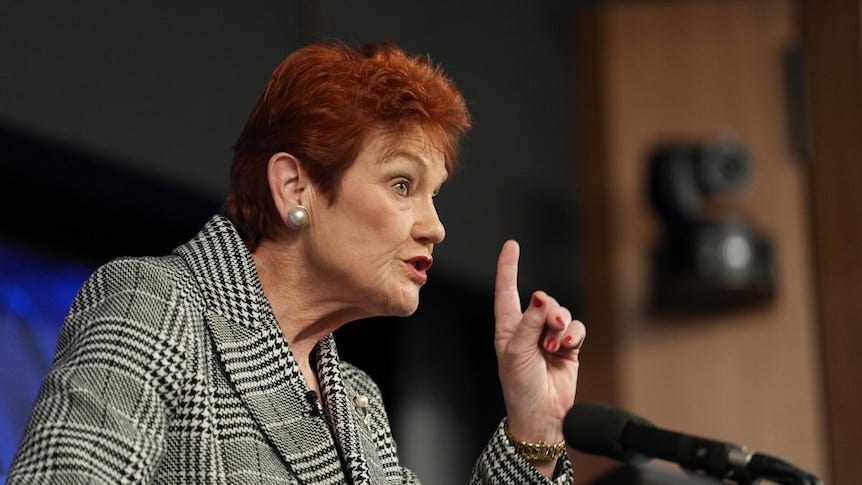
The gap between what Hanson says and what sustains her operation reveals far more than any of her erratic National Press Club remarks ever could, write Toyo White and Jovilyn Rabino.
Want to support our work? Cheek is offering 30% off annual subscriptions until June 30, meaning you can get access to ALL of our content for just $49 a year!!
Of all the parties to be caught offshoring work, Pauline Hanson’s One Nation was not an obvious candidate.
As headlines about the party sending labour to the Philippines spread yesterday, much of the coverage focused on the hypocrisy. But for us as mixed-race Filipino-Australians, there was an omission that told a deeper story.
The people reportedly being underpaid weren’t some abstract offshore workforce. They were people who looked like our families.
Legacies of division
For many migrants, and by extension their children, Hanson’s rhetoric isn’t abstract - it’s familiar.
In 1996, the senator claimed Australia was at risk of being “swamped by Asians”, arguing that Asian migrants “form ghettos and do not assimilate”. That was squarely aimed at preventing people like our parents from ever being able to enter this country. Hanson’s life’s work was to undermine an individual from being able to move across borders, especially when their skin was darker.
That language didn’t disappear, even after Hanson’s first parliamentary stint was over. It lingered in the background of schoolyards and workplaces - in the ways belonging is quietly questioned for some of us and granted to others.
Kids like us, raised in the diaspora, grow up moving between worlds. We translate for our parents, code-switch between cultures, and learn early that being “from here” is something some people are expected to prove. In our case, that burden often fell on our parents.
So when the same political project that built its identity not only on rejecting multicultural Australia, but on vilifying it, also relies on outsourced Filipino labour to run its digital campaigns, the contradiction is impossible to ignore.
A project which had spent years claiming that migrants were replacing the jobs of Aussie Battlers, only to themselves expose that this was always a decision made to cut corners and costs, and to outsource that work back to the Global South.
This isn’t simply globalisation; it is labour structured around exploitation and underpayment.
The gap between what Hanson says and what sustains her operation reveals far more than any of her erratic National Press Club remarks ever could.
Cutting wages and cutting corners
Much of the coverage has focused on how this impacts Australian workers, highlighting the contrast with One Nation’s long-standing criticism of Australians competing with “cheap foreign labour”. But there was little attention given to the Filipinos on the other end, who are often underpaid and undervalued for their work.
As reported, these Filipinos were working as “Virtual Assistants”, helping create material for One Nation’s social media. The going hourly rate for this kind of role is between 4-8 AUD, well below what someone doing equivalent work in Australia would be paid.
It seems that One Nation’s decision was simply grounded in the fact that it could pay workers less by hiring from countries with lower wages, weaker labour laws, and fewer practical barriers to labour exploitation.
And while $4 AUD an hour is only marginally higher than the average wage in Metro Manila - around $3.70 AUD - it reflects the central contradiction at the heart of offshoring for countries like the Philippines. The work exists because it is cheap; if labour costs rise, companies in places like Australia are unlikely to offshore there.
One Nation is far from a unique employer here, but it has explicitly argued that this phenomenon is regrettable-for the Australian worker. It seems that when it’s about saving themselves a buck, One Nation’s principles fall away.
Walang Kwenta - the emptiness of One Nation’s ‘principles’
It seems hard to believe that One Nation was strapped for cash. After all, the party is backed by Australia’s wealthiest person, and just raised more than 4.3 million AUD in a crowdfunding campaign. Would there have really been a struggle to afford paying someone a reasonable wage to do this work?
At the Press Club, Hanson reiterated her call for Australia to be “monocultural” and cited the 2021 Census, noting that 23 per cent of Australians speak a language other than English at home. People were right to notice a certain contradiction with her seemingly international workforce.
This is far from the first time that One Nation has been caught saying one thing whilst doing another. It reveals an empty political project, and that Australia’s challenge is not multiculturalism itself, but the convenience of treating it as a scapegoat for deeper failures of political leadership and economic policy.
About the author
Thomas (or Toyo) White is a Filipino-Australian community worker, grassroots organiser, and undergraduate student in Naarm / Melbourne. Across 2024 and 2025, he spent a year abroad in the Philippines where he studied, worked, and reconnected with family. He is currently a Victorian Greens candidate in the upcoming state election for the seat of Glen Waverley, and wants to do what he can to advocate for the diverse communities he comes from.

Jovilyn Rabino is a Filipino-Australian communications advisor based in Melbourne. She currently works as an advisor to Anasina Gray-Barberio MP, Victorian Greens spokesperson for multiculturalism and anti-racism. Jovilyn holds an undergraduate degree in Human Rights and is passionate about anti-racism, multicultural youth advocacy, and increasing the participation of diverse young people in civic, academic, and political spaces.

So proud to have worked on this piece with Jovilyn, and to talk about a part of this issue that wasn't getting considered.
Thank you to Cheek for helping platform this perspective!
Completely agree, this is because gina is writing the policies, as that's what gina rinehart wants to do with her workers. Hanson has always been in the billionaires back pocket, her policies are exactly from the trumpstein/heritage foundation playbook!