
When disabled children are killed, our public empathy goes to the wrong place
By Sarah Langston
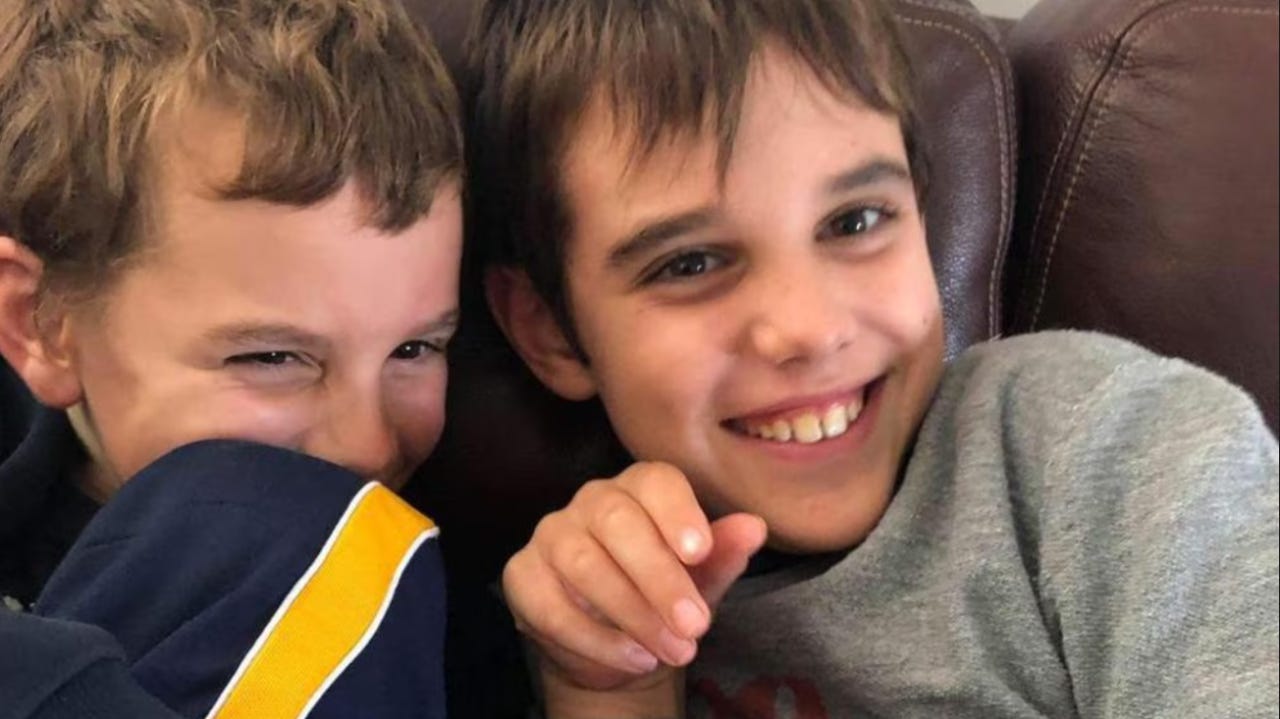
Last week, autistic brothers Otis and Leon Clune were allegedly killed by their parents in a suspected murder-suicide. Australian Neurodivergent Parents Association president Sarah Langston explains why the language we use when discussing their deaths, and who we choose to centre, is critical.
Content advice: this article discusses murder, filicide, suicide, and ableism.
Pieces like this one are free to read. Please consider becoming a paid subscriber so Cheek can continue paying writers for their insight and expertise.
I am a neurodivergent parent raising a neurodivergent child. When I read that a disabled child has been killed by their parent, my focus is on the child, not on the perpetrator who committed the crime. I want to know who they were, what they loved, and what the Australian community has lost because they were murdered. My concern is justice for them and how they are remembered.
One of the ways we deliver justice for children murdered by their parents is through the language we use to describe what was done to them.
That has been the approach of the Australian Neurodivergent Parents Association over the last 24 hours in responding to the premeditated murder of Leon and Otis Clune by their parents in Western Australia, which has been the subject of intense media coverage and social media speculation over recent days. Our response has been measured and deliberate, focused on how to respond in ways that honour the two boys, place them at the centre, and guide discussions in ways that do not cause further harm to other disabled children and adults.
This position is grounded in prevention and harm reduction. It reflects decades of leadership by disabled people on filicide, the killing of a person by a family member. It is also informed by research and evidence-based guidance from the Monash Deakin Filicide Research Hub, which emphasises careful language, the avoidance of speculation, and a clear focus on risk and prevention.
A caveat: focusing on risk and prevention is not the same as expressing empathy for perpetrators. There is no circumstance in which murdering a child is acceptable or understandable. Saying this plainly is important.
That approach often makes people uncomfortable. The dominant public response in these cases is to centre the parents’ distress, isolation, or lack of support, and that has been dominant in media coverage of this devastating crime. Deaths are framed as “family tragedies”, and the public is encouraged to understand how things must have become so unbearable. In some cases, senior political leaders adopt this framing as well.
In that process, the child disappears.
This matters: because how we talk about these deaths shapes what we excuse, what we normalise, and what we fail to prevent.
When non-disabled children are killed, public discussion does not usually begin with explanations for the perpetrator. Sympathy is not extended before facts are established. There is a shared understanding that a serious crime has occurred and that responsibility lies solely with the person who committed it. Murdering a child is a crime, and the person who murders them is a criminal. We need to use the right words; the words we would for any other homicide.
When the child is disabled, that clarity and precision of language often fades. Disability becomes context, then explanation, and sometimes? Justification.
This is not accidental. It reflects a deeper assumption that disabled lives are more burdensome and therefore more understandable to lose. That assumption appears in policy settings, funding decisions, and service design long before it shows up in media coverage. When a child is murdered, it suddenly becomes more visible and scattered across every comments section on Facebook and Instagram.
So now is the time for us, as a community that was responsible for these children, to step up in their memory. There is a moral responsibility to educate ourselves on best practices and to ensure we do not dishonour them in the words we choose, nor put their peers at future risk.
Three bodies of work are particularly relevant here.
The first is Disability Memorial, an online project created by disability advocates to document the lives of disabled people who have been killed by family members or caregivers. It exists because these deaths are routinely minimised or erased. By centring victims rather than perpetrators, the memorial shows that this violence is neither rare nor anomalous.
The second is Addressing Filicide, linked to the Monash Deakin Filicide Research Hub. This research builds on Australia’s national filicide studies and focuses on identifying patterns, risk factors, and system failures so that deaths can be prevented. Importantly, this work does not argue for excusing perpetrators. It seeks to understand risk in order to intervene earlier.
The third is the 2026 Anti-Filicide Toolkit from the Autistic Self Advocacy Network which you can find right here.
Taken together, these sources clearly show two things: Disabled children are being killed, and these deaths are foreseeable and preventable when systems function properly.
What sits between evidence and prevention is the public narrative, which consistently misdirects empathy.
There is also a common assumption that parents who refuse to empathise with perpetrators must have easier lives. That assumption is wrong. It is one we have strongly refused over the last day, and one we have had bitterly pitted against us by other parents of Disabled children who identify with the perpetrators of this crime. We have staunchly rejected the idea that there are two kinds of parent, and only those with “really bad” Autistic kids can understand the urge to kill them. Instead, we have insisted on the idea that murdering a child is never sympathetic and we do not identify with, nor ally ourselves with, perpetrators of this violence.
Many parents who hold a firm line against empathising with child killers are raising children with very high and complex support needs. Some are parenting adult children who require constant co-regulation. Some live supporting children with daily self-injury, violence, property destruction, repeated hospitalisation, sleep deprivation, incontinence and exclusion from school and other systems. Many have lost all or some of their NDIS funding in the last 12 months.
Many are doing this in deep poverty. Some change dozens of cloth nappies day and night because there is no funding for continence aids, and their children struggle with severe encopresis. Some barricade themselves in rooms during periods of extreme dysregulation for their children who are threatening them with serious harm, in a state of distress or psychosis or sensory overload or OCD-related rage.
These realities are well known within disabled communities, including within ANPA. None of them are the fault or intention of children, who are distressed and rely on us for support and safety. They are disabled, and as much as it is hard for us as their parents to experience this with them, it is so much harder for them. No child wants to feel chronically overwhelmed, in pain, or angry. They need us to always see this first and last through their eyes, with a focus on their dignity, safety, and human rights.
What is striking is when these circumstances are taken seriously and what happens in response. Often, they are raised only after a child has been killed, to explain why the killing should be understood and empathised with. They are rarely treated as reasons for Federal and State governments to get organised, to fund support properly or intervene early, and that is a moral failure on their part.
And still, with all of this in mind, we must recognise that the vast majority of parents do not kill their children.
That fact matters because it speaks to a moment of agency and choice. Hard lives do not excuse homicide, and there is always another way out. Poverty does not make killing understandable. Isolation does not remove criminal or moral responsibility.
Importantly: Disability does not reduce a child’s right to life.
This is not an argument against examining systems. Systems demand scrutiny, particularly as cuts to the NDIS continue to reshape disability support. Reporting by Rick Morton in The Saturday Paper has shown that around one third of reassessed NDIS plans have been cut, leaving many families with fewer supports at the point of greatest need. Systemic neglect must be named because it matters for prevention.
But explanation is not justification. We cannot cross that line, and many have in the last 24 hours.
When a parent kills their child, a serious criminal and human rights offence has occurred. Where a parent kills a child and then dies by suicide, the absence of a trial does not erase responsibility for the killing. Disability, poverty, or lack of support do not change that.
Disabled children are not expendable. They are not a separate category of child whose deaths require softer language or lower standards of judgment for the people who chose to hurt them. They are not “lost” or “taken” and their deaths are not inevitable tragedies.
They are children who were murdered by the people tasked with protecting them.
Their right to life and safety does not vary or diminish with service gaps, funding cuts, or parental distress. Treating it as conditional is not compassion: It is rank discrimination.
If our public conversation cannot hold that line, it is not neutral. It is making a choice about whose lives are valued and whose deaths can be explained away.
Too often, it chooses the wrong side. We ask other parents to start choosing the right side today.
This article was originally shared by the Australian Neurodivergent Parents Association on their LinkedIn page. It has been republished with permission.
About the author
Sarah Langston
Sarah is a neurodivergent parent to a neurodivergent child, and a disability advocate. She is the president of the Australian Neurodivergent Parents Association (ANPA) and the recipient of the 2025 Disability Rights Activism Award.
‘When systems work well’. They don’t though and that is deliberate. The people in power don’t care about anything but themselves and view any government service that needs to be delivered to its own people as a nuisance. This is in particular true for the NDIS which has been used to bolster a federal budget (Morrison) or to position themselves for a lucrative position in the private sector (Shorten).
We as disabled people are a pawn at best in someone else’s game.
It is crucially important to highlight how the public narrative is manipulated and how it directly impacts disabled people already living in isolation. We are not wanted by default and this is NEVER challenged by those with all the privilege. This mistreatment does not justify murder but it shows how people have normalised looking the other way when someone, a family struggles. There are tragedies within in this tragedy that remain unresolved and unaddressed.
Thank you for sharing this very important article.